USA EB-5 January Update


The 2026 Visa Bulletin and the Strategic Imperative of Rural Set-Asides for Indian and Chinese Investors
The publication of the January 2026 Visa Bulletin by the U.S. Department of State marks a watershed moment in the history of the EB-5 Immigrant Investor Program. For stakeholders, legal practitioners, and, most crucially, the prospective investor class from high-demand nations such as India and China, the data presented in this bulletin serves as both a beacon of immediate opportunity and a harbinger of imminent structural closure. While the headline advancements in the Unreserved categories—particularly the dramatic forward movement for Indian nationals—suggest a loosening of the decades-long gridlock that has defined the program, a deeper forensic analysis of the underlying inventory data reveals a more complex and potentially treacherous landscape.
The central thesis of this report is that the apparent stability of the "Current" status for Set-Aside categories in the January 2026 Bulletin is a lagging indicator that masks a profound and accelerating imbalance between supply and demand, specifically within the High Unemployment (Urban) Targeted Employment Area (TEA) category. We posit that for Indian and Chinese investors seeking a predictable, risk-mitigated pathway to United States permanent residency, the Rural Set-Aside category has emerged not merely as a viable option, but as the only mathematically robust channel capable of weathering the coming storm of visa retrogression.
This conclusion is derived from a triangulation of three critical data vectors. First, the statutory mandate of "Priority Processing" for Rural petitions has created a bifurcated adjudication timeline, where Rural investors are reaching approval in fewer than six months while their Urban counterparts face waits extending beyond two years. Second, the "Invisible Backlog"—comprised of thousands of filed but unadjudicated I-526E petitions—has already effectively exhausted the High Unemployment visa supply for the next half-decade, a reality not yet reflected in the Visa Bulletin due to processing latencies. Third, the "crowding out" effect of Rest of World (ROW) investors in the Urban category is systematically eroding the visa availability for country-capped nationals, a dynamic that is significantly less acute in the Rural sector due to its larger 20% visa allocation.
In the ensuing sections, this report will provide an exhaustive deconstruction of the January 2026 Visa Bulletin, followed by a rigorous examination of the petition inventory data that remains hidden from public view. We will explore the mechanics of the Child Status Protection Act (CSPA) in the context of priority processing, the economic evolution of rural projects from "last resort" to "institutional grade," and the strategic necessity of locking in priority dates before the statutory sunset of the program in 2027. The evidence suggests that while the door to America remains open, the aperture is narrowing, and the Rural Set-Aside represents the last reliable threshold for the high-net-worth investor.
1. The Post-RIA Paradigm: A Structural Revolution
To fully comprehend the gravity of the January 2026 Visa Bulletin, one must first situate it within the legislative framework that birthed it: the EB-5 Reform and Integrity Act of 2022 (RIA). The RIA was not merely a reauthorization; it was a fundamental restructuring of the program's DNA, designed to correct the geographic imbalances of the past and to provide a lifeline to investors trapped in the retrogression quagmire.
1.1 The Bifurcation of the Queue
Prior to March 2022, all EB-5 investors—regardless of whether they invested in a luxury hotel in Manhattan or a manufacturing plant in rural South Dakota—competed for the same pool of approximately 10,000 visas. This monolithic queue inevitably favored projects in major metropolitan areas, leading to a saturation of capital in urban centers and a neglect of the rural economic development that Congress originally intended to foster. The consequence for investors from China, and later India, was a catastrophic backlog. By 2021, a Chinese investor faced a wait time exceeding 15 years, rendering the program functionally obsolete for families with children.
The RIA shattered this monolith by carving out three distinct "reserved" queues, or Set-Asides, which function independently of the general (Unreserved) line.
- Rural Area (20%): Reserved for investments in areas outside metropolitan statistical areas (MSAs) or towns with populations under 20,000.
- High Unemployment Area (10%): Reserved for investments in areas with unemployment rates at least 150% of the national average.
- Infrastructure (2%): Reserved for government-administered public works projects.
This segmentation meant that a new investor filing after March 15, 2022, was no longer standing behind the 50,000+ legacy applicants in the Unreserved line. They were effectively entering an empty room. However, as we approach 2026, that room is no longer empty. It is crowding rapidly, and the dynamics of how these lines fill—and how fast they move—are dictated by the specific allocation percentages and processing speeds mandated by the RIA.
1.2 The Mandate of Priority Processing
Perhaps the most consequential provision of the RIA was the introduction of "Priority Processing" specifically for Rural investors. The statute explicitly directs United States Citizenship and Immigration Services (USCIS) to prioritize the adjudication of petitions associated with Rural TEAs. In the bureaucratic machinery of USCIS, "prioritize" has translated into a distinct operational workflow.
While standard EB-5 petitions (both legacy and new Urban filings) languish in queues with processing times ranging from 24 to 48 months, Rural petitions have consistently seen adjudication turnaround times of 3 to 10 months throughout 2024 and 2025.1 This disparity is not a temporary anomaly; it is a feature of the law. The implications of this speed are profound. In the context of the Visa Bulletin, speed equates to visibility. A Rural investor's petition is approved quickly, allowing them to become "documentarily qualified" at the National Visa Center (NVC) and claim a visa number. Conversely, an Urban investor's petition sits at USCIS for years. During this time, they are invisible to the State Department. They do not appear on the waiting list until they are approved. This lag creates the "Invisible Backlog"—a phantom inventory of investors who have "bought" a ticket but haven't yet entered the line.
1.3 The Grandfathering Assurance
The RIA also introduced a critical safety net: grandfathering. Investors who file their I-526E petitions on or before September 30, 2026, are protected from future legislative lapses.2 Even if the program is not reauthorized in 2027, these investors remain eligible to process their green cards. This looming deadline creates a "use it or lose it" psychological pressure that is expected to drive a massive surge in filings throughout 2026. As this wave of capital crashes into the system, the limited capacity of the High Unemployment category (only roughly 2,000 visas per year) will be overwhelmed first, leaving the larger Rural category (roughly 4,000 visas per year) as the only remaining outlet for capacity.
2. Deconstructing the January 2026 Visa Bulletin
The January 2026 Visa Bulletin is a document of stark contrasts, offering a mix of unprecedented advancement for legacy cases and deceptive stability for post-RIA filings. To understand the strategic landscape, we must analyze the two primary components of the bulletin: The Final Action Dates (Chart A) and the Dates for Filing (Chart B).
2.1 Unreserved Categories: The "India Surprise"
The most shocking development in the January 2026 Bulletin is the movement in the Unreserved category for India.
- Final Action Date: Advanced from July 1, 2021, to May 1, 2022.3
- Dates for Filing: Advanced by over two years to May 1, 2024.3
This movement places the Unreserved cutoff date after the enactment of the RIA. On the surface, this might suggest that the backlog for Indian investors has cleared. However, such an interpretation would be a dangerous error. The advancement is likely the result of several converging factors:
- Processing Efficiency: USCIS and the State Department may have efficiently processed a specific cohort of applications, clearing the immediate inventory.
- Attrition: Many Indian investors from the 2019–2021 period may have abandoned their petitions, withdrawn due to long wait times, or switched to other visa categories, leaving gaps in the line that allowed the date to jump forward.
- The "Post-RIA" Gap: There was a lull in filings immediately following the RIA's passage as the market adjusted to the new rules and higher investment amounts ($800,000 vs. $500,000). The bulletin is currently moving through this low-volume period.
Implication: For a new Indian investor in 2026, the Unreserved category remains a trap. Once the post-RIA filings (those filed in late 2022, 2023, and 2024) begin to reach the visa stage, the demand will far outstrip the supply. The Unreserved line will effectively become the "overflow" parking lot for thousands of investors who failed to secure a reserved visa. Analysts project that the actual wait time for a new Unreserved filing today is between 7 and 10 years.4
2.2 China Unreserved: The Glacier Moves
For Mainland China, the Unreserved Final Action Date advanced to August 15, 2016.3 While any movement is positive, the reality remains grim. A Chinese investor who filed in late 2016 is only now, in 2026, becoming eligible for a visa. This ten-year lag confirms the structural incapacity of the Unreserved category to handle Chinese demand. For a new Chinese investor, the Unreserved category is functionally closed; the wait times would exceed the foreseeable future of the program's authorization.
2.3 The Set-Aside Categories: The "Current" Mirage
Crucially, all three Set-Aside categories—Rural, High Unemployment, and Infrastructure—are listed as "Current" (C) for all countries.5 This status is the primary driver of the current market narrative, leading many to believe that "all is well" in the Urban TEA market.
However, "Current" in the context of the Visa Bulletin does not mean "Empty." It simply means "Available Now." It reflects the status of the visa supply relative to the number of documentarily qualified applicants reported to the National Visa Center. It does not account for the thousands of applicants currently sitting in the USCIS adjudication pipeline.
- The Lag Effect: Because Urban TEA petitions take 24+ months to adjudicate, an investor who filed in 2024 is still waiting for approval in 2026. They are not yet visible to the State Department. The Visa Bulletin is therefore looking in the rearview mirror. It shows the demand from 2022/2023 that has successfully navigated the slow USCIS process. It does not show the tidal wave of 2024/2025 filings that is about to crash onto the shore.
When USCIS accelerates its processing—or simply as time passes and the 24-month clock runs out—these thousands of Urban investors will suddenly appear at the NVC. At that moment, the "Current" status will vanish, replaced by a cutoff date that could retrogress years into the past. This phenomenon is known as the "Retrogression Cliff."
3. The Mechanics of the "Invisible Backlog"
To quantify the risk of the Retrogression Cliff, we must look beyond the Visa Bulletin to the inventory data provided by USCIS and aggregated by industry watchdogs like the American Immigrant Investor Alliance (AIIA).
3.1 Inventory Analysis: Urban vs. Rural
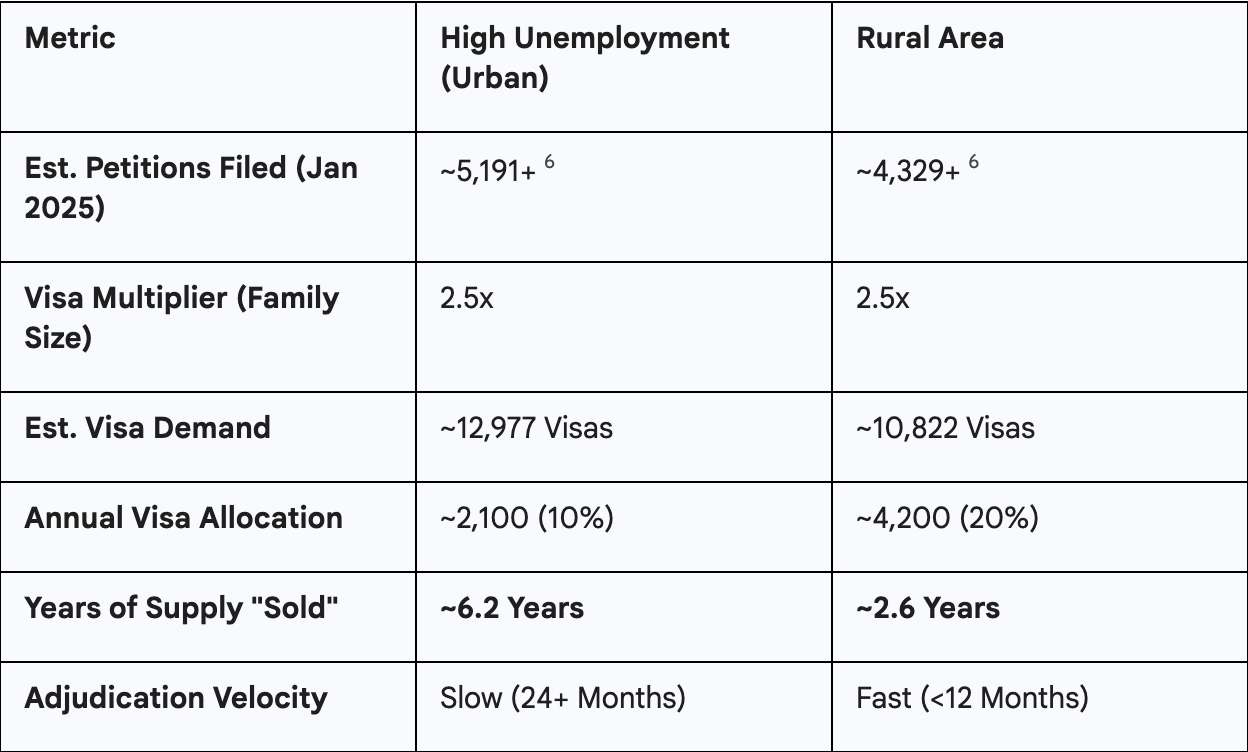
As of early 2025, the filing data presents a stark dichotomy between the High Unemployment and Rural categories.
3.2 The High Unemployment Trap
The data indicates that the High Unemployment category is already functionally oversubscribed for the next six years.
- The Math: There are roughly 5,191 petitions filed. If each petition results in 2.5 visas (investor + spouse + 0.5 child average), the total demand is nearly 13,000 visas.
- The Supply: The annual limit is roughly 2,100 visas (plus any carryover).
- The Consequence: Even with generous carryover assumptions, the current inventory exceeds the supply by a factor of three to four.
- The Trap: An investor filing in an Urban project in 2026 is joining the back of this 13,000-person line. They are paying $800,000 to enter a queue that will not service them until roughly 2032. Yet, because the Bulletin says "Current" (due to slow processing), they are unaware of this reality.
3.3 The Rural Buffer
The Rural category shows a different profile.
- The Math: With ~4,329 petitions, the demand is roughly 10,800 visas.
- The Supply: The annual limit is double that of Urban: ~4,200 visas.
- The Buffer: While 10,800 > 4,200, the "years to clear" metric is significantly lower—roughly 2.6 years.
- The Critical Difference: Because Rural petitions are processed quickly (Priority Processing), the "Invisible Backlog" is much smaller. Rural investors move from "Filed" to "Visa Ready" in months, meaning the Visa Bulletin for Rural is a much more accurate reflection of reality than it is for Urban. When the Rural bulletin says "Current," it is a truer "Current" because the lag time is minimal.
4. The Strategic Supremacy of Rural Set-Asides
For Indian and Chinese investors, the choice of Rural Set-Asides is driven by three strategic imperatives: Priority Processing, the 20% Allocation, and the mitigation of ROW displacement.
4.1 Priority Processing: The Ultimate Hedge
In the world of EB-5, time is the enemy. Time creates retrogression risk, time ages out children, and time exposes capital to market volatility. Priority Processing is the only statutory mechanism that defeats time.
The CSPA Advantage:
The Child Status Protection Act (CSPA) allows a child's age to be "frozen" while the I-526E petition is pending. However, the age unfreezes upon approval. If a visa is not immediately available at the moment of approval, the child begins to age again.
- Urban Risk: An Urban petition might be pending for 3 years. The child is safe during this time. But if the petition is approved in 2029, and by then the Urban category has retrogressed to 2024 (a likely scenario given the backlog), the visa is not available. The child's age unfreezes, and they may age out while waiting for the priority date to become current.
- Rural Safety: A Rural petition is approved in 6 months. Because the Rural category has a deeper supply and is less likely to retrogress deeply, the visa is likely available at the moment of approval. The investor can lock in the child's age by filing for adjustment of status or paying the NVC fee immediately.7
Redeployment Mitigation:
EB-5 capital must remain "at risk" and "sustained" for a statutory period (now generally interpreted as two years of deployment). In Urban projects with long adjudication times, capital can be locked up for extremely long periods, often requiring "redeployment" into new, potentially riskier assets if the original project pays out before the immigration process is complete. Priority processing allows the immigration phase to conclude closer to the natural investment cycle of the project, simplifying the exit strategy.
4.2 The 20% Allocation and Carryover Mechanics
The 20% set-aside for Rural projects (approx. 4,000+ visas) is a massive structural advantage.
- The Carryover Cushion: Under the RIA, unused visas in a set-aside category carry over to the same category for the next fiscal year. Because Rural projects historically had lower demand, the category accumulated a significant number of unused visas from FY2022, FY2023, and FY2024. This "carryover cushion" effectively expands the Rural capacity well beyond the base 4,000 limit for FY2026.
- Urban Burn Rate: Conversely, the High Unemployment category (10%) has seen higher demand. It burns through its annual allocation and its carryover much faster. Once the carryover is gone, it hits a hard wall of ~2,000 visas per year. Rural will hit this wall much later, providing a longer runway for investors filing in 2026.8
4.3 The "Crowding Out" Effect: ROW Dominance in Urban
One of the most dangerous dynamics for China and India is the behavior of the Rest of World (ROW).
- ROW Preferences: Investors from Europe, Latin America, and other non-backlogged nations overwhelmingly prefer Urban real estate projects. They perceive them as safer and more prestigious.
- The Cap Squeeze: Under US law, each country is capped at 7% of the total visas unless there are leftover visas that would otherwise go unused.
- The Urban Scenario: In the High Unemployment category, ROW demand is so high that it is consuming nearly the entire 10% allocation. This means there are no leftovers for China and India to inherit. Chinese and Indian investors are restricted to their strict 7% cap (approx. 140 visas each per year). With thousands of applicants, the line moves at a glacial pace.4
- The Rural Scenario: While ROW interest in Rural is growing, it is historically lower than in Urban. This leaves a larger portion of the Rural allocation unclaimed by ROW, allowing these "leftover" visas to flow to the applicants with the earliest priority dates—Chinese and Indian investors. This "spillover" effect is the engine that keeps the Rural line moving for high-demand countries.
5. Country-Specific Implications
5.1 India: Navigating the H-1B Pivot
For Indian nationals, the EB-5 program is often a strategy to escape the decades-long H-1B/EB-2/EB-3 backlog.
- The Concurrent Filing Opportunity: The most immediate benefit for Indians residing in the US is Concurrent Filing. By filing an I-485 alongside the I-526E, they receive an Employment Authorization Document (EAD) and Advance Parole (AP). This provides freedom from H-1B employer dependence.
- Why Rural is Critical: To file Concurrently, the Visa Bulletin must be "Current" (or the Date for Filing must be open). While both Rural and Urban are Current now, the Urban category is on the precipice of retrogression. If an Indian investor prepares an Urban petition but the Bulletin retrogresses before they file, they lose the Concurrent Filing window. Rural, with its deeper supply, offers a much wider and more reliable window for locking in this benefit.10
5.2 China: Breaking the Decade Cycle
Chinese investors are in a unique position. They have witnessed a 10-year backlog in the Unreserved category.
- The Psychology of "Guaranteed": Chinese investors are uniquely sensitive to retrogression. The Rural Set-Aside is the only category that mathematically allows a Chinese investor to bypass the ROW crowding effect described in Section 4.3.
- The Inventory Reality: Chinese nationals account for roughly 52% of all post-RIA filings.6 However, this demand is split between Urban and Rural. The Urban demand from China is competing with the massive ROW demand. The Rural demand from China is largely competing only with other Chinese investors (and a smaller Indian cohort), making the wait time essentially a function of Chinese volume rather than global volume. This predictability is valuable.
6. The Evolution of Rural Projects: From Risk to Institutional Grade
A common objection to the Rural strategy is the perception of financial risk. "Why invest in a hotel in the middle of nowhere when I can invest in a tower in Manhattan?" This perception is outdated and dangerous.
6.1 The Capital Shift
The RIA's incentives have forced the market to adapt. Major institutional developers—who previously focused exclusively on Tier 1 cities—have pivoted to Rural markets to access the EB-5 capital pool.
- Institutional Quality: We are now seeing "Rural" projects that are actually high-end resorts in popular vacation destinations (which qualify due to low permanent population), master-planned communities on the exurban fringe of major cities, and essential infrastructure projects backed by government revenue bonds.
- Due Diligence: The "Rural" label no longer implies a lack of economic viability. However, investors must still scrutinize the "Rural" designation. The project must be outside an MSA or in a town of <20,000. With the new scrutiny from USCIS, projects that aggressively gerrymander maps are at risk of denial. Safety lies in projects that are clearly, undeniably rural by statutory definition.11
7. The 2027 Sunset and the Grandfathering Imperative
The EB-5 Regional Center Program is authorized through September 30, 2027.
- Legislative Risk: While the program is likely to be reauthorized, the political climate is unpredictable.
- Grandfathering Protection: The RIA includes a robust grandfathering clause. Any petition filed on or before September 30, 2026, continues to be processed under the current rules, even if the program expires.2
- The 2026 Surge: This deadline ensures that 2026 will see a frantic acceleration of filings. This "rush to the door" will exacerbate the backlogs discussed in this report. Investors who wait until late 2026 to file will likely find themselves at the back of a very long line, potentially facing the very retrogression they sought to avoid.
- First Mover Advantage: Filing early in 2026—specifically in Rural projects with Priority Processing—allows the investor to potentially be adjudicated and approved before the September deadline, locking in their status with the highest degree of certainty.
8. Conclusion: The Narrowing Path
The January 2026 Visa Bulletin is a deceptive document. Its rows of "Current" dates suggest a calm sea, but the sonar of inventory data reveals a massive iceberg beneath the surface of the High Unemployment category.
For the Indian or Chinese investor, the Unreserved category is a relic of the past, mired in a backlog that will take years to clear. The High Unemployment Set-Aside is a crowded theater with a single exit, already oversold and awaiting the inevitable fire alarm of retrogression.
The Rural Set-Aside stands alone as the rational choice. It is the only category that aligns the three critical components of a successful immigration strategy:
- Speed: Priority processing mitigates CSPA and redeployment risks.
- Capacity: A 20% allocation and carryover cushion provide resilience against demand surges.
- Sovereignty: Reduced competition from ROW investors allows high-demand nationals to access visas based on their own priority dates rather than being blocked by global caps.
The window is open, but it is closing. The "Guaranteed Path" exists, but only for those who recognize the difference between the data on the Bulletin and the reality in the pipeline. In 2026, Rural is not just an option; for the astute investor, it is the only strategy.
9. Appendix: Comprehensive Data Tables
Table 1: Comparative Analysis of EB-5 Categories (Jan 2026 Status)

Table 2: Estimated Wait Times for New Investors (China/India)

Note: Estimates based on current adjudication trends and AIIA inventory data as of Jan 2025.
10. Glossary of Terms
- Retrogression: The movement of the Visa Bulletin cutoff date backward in time due to demand exceeding supply.
- Priority Processing: A statutory requirement for USCIS to adjudicate Rural petitions faster than other categories.
- Set-Aside: Visas reserved specifically for TEAs (Rural, High Unemployment, Infrastructure).
- Carryover: Unused visas from one fiscal year that are added to the allocation of the next year.
- CSPA (Child Status Protection Act): Federal law that allows certain beneficiaries to retain "child" status beyond age 21.
- Concurrent Filing: The ability to file Form I-485 (Adjustment of Status) at the same time as Form I-526E, provided the visa category is "Current."
Disclaimer: This report is for informational purposes only and does not constitute legal or financial advice. Immigration laws and visa bulletin dynamics are subject to change. Investors should consult with qualified immigration counsel and financial advisors.
Works cited
- What Is the Current Waiting Time for an EB-5 Visa? | EB5 Visa Investments, accessed January 7, 2026, https://eb5visainvestments.com/2025/10/23/what-is-the-current-waiting-time-for-an-eb-5-visa/
- EB-5 at a crossroads: What 2026 holds for investors, projects, and policy - EB5Investors.com, accessed January 7, 2026, https://www.eb5investors.com/blog/eb-5-at-a-crossroads-what-2026-holds-for-investors-projects-and-policy/
- January 2026 Visa Bulletin: Key Movements and EB-5 Advancements for China, accessed January 7, 2026, https://www.eb5insights.com/2025/12/22/january-2026-visa-bulletin-key-movements-and-eb-5-advancements-for-china/
- EB-5 Updates | immigrant investor program news, accessed January 7, 2026, https://blog.lucidtext.com/
- Visa Bulletin For January 2026 - Travel.gov, accessed January 7, 2026, https://travel.state.gov/content/travel/en/legal/visa-law0/visa-bulletin/2026/visa-bulletin-for-january-2026.html
- Following AIIA Lawsuit, USCIS Releases Detailed I-526/I-526E Petition Data Through Jan. 31, 2025 | EB-5 Insights, accessed January 7, 2026, https://www.eb5insights.com/2025/05/13/following-aiia-lawsuit-uscis-releases-detailed-i-526-i-526e-petition-data-through-jan-31-2025/
- EB-5 Visa Process & Timeline 2026 - Step-by-Step Guide - EB5 United, accessed January 7, 2026, https://www.eb5united.com/eb5-visa/timelines-process/
- About the EB-5 Visa Classification - USCIS, accessed January 7, 2026, https://www.uscis.gov/working-in-the-united-states/permanent-workers/employment-based-immigration-fifth-preference-eb-5/about-the-eb-5-visa-classification
- EB-5 Visa Limits: Impact on Program Growth | CanAm Enterprises, accessed January 7, 2026, https://www.canamenterprises.com/2025/12/29/eb5-visa-number-opportunity-and-threat/
- EB-5 in 2026: Key Visa Trends, Processing Dynamics, and What Investors Should Know Heading Into the New Year - Canam Enterprises, accessed January 7, 2026, https://www.canamenterprises.com/2025/12/04/eb-5-in-2026-key-visa-trends-processing-dynamics-and-what-investors-should-know-heading-into-the-new-year/
- Why EB-5 Investors Should Consider Rural Targeted Employment Area Projects - EB5AN, accessed January 7, 2026, https://eb5visainvestments.com/2025/07/09/why-eb-5-investors-should-consider-rural-targeted-employment-area-projects/
- Understanding the Differences Between EB-5 Rural Projects and High Unemployment Projects - Fragomen, accessed January 7, 2026, https://www.fragomen.com/insights/understanding-the-differences-between-eb-5-rural-projects-and-high-unemployment-projects.html